Frequently Asked Questions

Welcome to our FAQ page! Here you’ll find answers to some of the most common questions about our olive trees, plant care, delivery options, and more. Whether you’re a first-time buyer or a returning customer, we’re here to make your experience with The Norfolk Olive Tree Company as smooth as possible.

Can’t find what you’re looking for? Feel free to get in touch — we’re always happy to help!

All visits are by appointment only. Antonia is available to arrange a visit to our beautiful nursery on the outskirts of Norwich.

To book an appointment please contact us on 07766730893 or email us [email protected]

If your olive tree is losing leaves, it’s often due to underwatering—especially if it’s in a pot. Olive trees need regular watering during the growing season (spring to autumn), and this is especially important for trees in containers or recently planted in the ground.

To help your olive tree recover:

  • Water consistently, especially during hot, dry spells.

  • Feed with a high-potassium fertiliser like tomato feed in spring and late summer.

  • Prune dead or damaged branches to encourage healthy regrowth.

Leaf loss can also occur naturally in winter or after environmental stress. With proper care, your tree should bounce back.

Black or purple spots on olive tree leaves are likely caused by Peacock Spot — a common fungal disease in the UK. It usually appears during damp, cool weather.

To treat Peacock Spot:

  • Apply Vitax Bordeaux Mixture in autumn and again in early spring to prevent infection.

  • Remove fallen, infected leaves to stop the fungus spreading.

  • Ensure good airflow around the canopy by pruning if needed.

Early treatment and good hygiene can keep your olive tree healthy all year round.

Olive trees are hardy and well suited to UK gardens. They can tolerate temperatures down to around -7°C without protection. At The Norfolk Olive Tree Company, we only recommend using fleece if there’s a sustained cold spell below -10°C.

To keep your olive tree thriving:

  • Choose a sunny, sheltered spot.

  • Avoid waterlogged soil in winter.

  • Only wrap with fleece during prolonged severe cold.

Olive trees are surprisingly resilient — with minimal winter protection, they will grow and thrive beautifully in most UK climates.

Yes. Olive trees are hardy and thrive in the UK when planted in free-draining soil. They also do well in large pots on sunny patios.
Hardy palms such as Trachycarpus fortunei (Chinese Windmill Palm) are ideal for Mediterranean-style gardens in the UK climate.
Once established, Mediterranean plants like olive trees, lavender and yucca are drought-tolerant, making them low-maintenance compared to traditional English borders.
Yes, olive trees are perfect for pots and containers, making them ideal for patios and balconies. Just be sure to use a free-draining soil mix and repot every few years.
Not all olive trees fruit equally well in cooler climates. The most reliable fruiting varieties for the UK are Arbequina, Picual, Leccino, and Frantoio. These cultivars cope better with lower summer heat levels, making them the best choice if you’d like your olive tree to produce a small but rewarding crop alongside its decorative value.
In the ground, olive trees can eventually reach several metres tall, though growth is slower in the UK. Potted trees usually stay more compact and are easy to manage with pruning. Even compact varieties like Arbequina can be shaped to suit smaller spaces while still producing fruit.

Olive trees prefer free-draining soil, ideally sandy or loamy with added grit. Heavy clay should be improved with sharp sand and compost to prevent root rot.
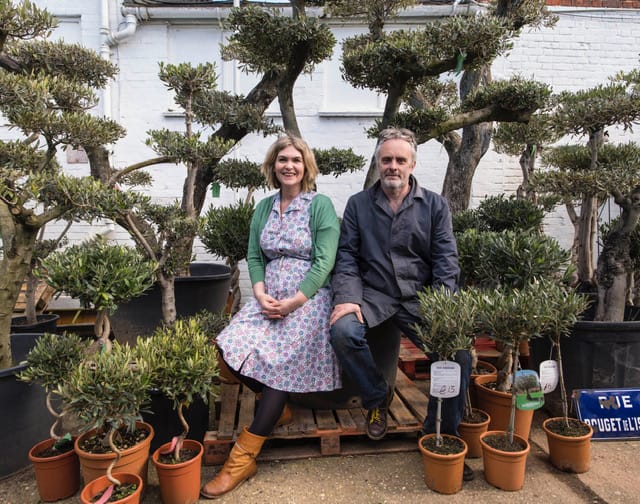
Yes, olive trees can produce small crops of fruit in warmer UK summers. Fruiting success also depends on variety — the best for the UK are Arbequina, Picual, Leccino, and Frantoio, which are more reliable in cooler conditions. While you may not harvest large quantities, the silvery foliage and structure remain the real star in most gardens.
Olive trees are hardy down to around –18 °C once established. In colder regions, it’s best to give extra winter protection such as fleece or positioning in a sheltered microclimate.
Palm trees grow slowly in the UK climate, with most hardy varieties adding just a few inches of trunk height each year. This makes them easy to maintain in smaller gardens.
Yes, many palms are surprisingly hardy in the UK, provided they’re given good drainage and a sheltered position. Some varieties withstand frost and even snow.
The Trachycarpus fortunei (Chinese Windmill Palm) is the hardiest choice for UK gardens. Other tough varieties include Chamaerops humilis and Phoenix canariensis (with winter care).
Compact varieties like Chamaerops humilis (dwarf fan palm) are perfect for small gardens. They bring a tropical feel without overwhelming limited space.
Palms like regular watering in summer, especially in pots, but dislike sitting in soggy soil. Feed with a balanced liquid fertiliser from spring to autumn to encourage lush growth.
Olive tree

Expert shipping

Carefully delivered to your home

Trees that’ll you love

Healthy trees Inspected by DEFRA

Hardy Trees

U.K Hardy Trees

100% Secure Checkout

PayPal / MasterCard / Visa